- java.lang.Object
-
- quarks.analytics.sensors.Filters
-
public class Filters
extends java.lang.Object
Filters aimed at sensors.
-
-
Method Summary
All Methods Static Methods Concrete Methods Modifier and Type Method and Description static <T,V> TStream<T>deadband(TStream<T> stream, Function<T,V> value, Predicate<V> inBand, long maximumSuppression, java.util.concurrent.TimeUnit unit)Deadband filter with maximum suppression time.static <T,V> TStream<T>deadband(TStream<T> stream, Function<T,V> value, Predicate<V> inBand)Deadband filter.
-
-
-
Method Detail
-
deadband
public static <T,V> TStream<T> deadband(TStream<T> stream,
                                        Function<T,V> value,
                                        Predicate<V> inBand,
                                        long maximumSuppression,
                                        java.util.concurrent.TimeUnit unit)
Deadband filter with maximum suppression time. A filter that discards any tuples that are in the deadband, uninteresting to downstream consumers.A tuple
tis passed through the deadband filter if:-
inBand.test(value.apply(t))is false, that is the tuple's value is outside of the deadband -
OR
inBand.test(value.apply(t))is true AND the last tuple's value was outside of the deadband. This corresponds to the first tuple's value inside the deadband after a period being outside it. -
OR it has been more than
maximumSuppressionseconds (in unitunit) - OR it is the first tuple (effectively the state of the filter starts as outside of the deadband).
- Type Parameters:
T- Tuple type.V- Value type for the deadband function.- Parameters:
stream- Stream containing readings.value- Function to obtain the tuple's value passed to the deadband function.inBand- Function that defines the deadband.maximumSuppression- Maximum amount of time to suppress values that are in the deadband.unit- Unit formaximumSuppression.- Returns:
- Filtered stream.
-
-
deadband
public static <T,V> TStream<T> deadband(TStream<T> stream,
                                        Function<T,V> value,
                                        Predicate<V> inBand)
Deadband filter. A filter that discards any tuples that are in the deadband, uninteresting to downstream consumers.A tuple
tis passed through the deadband filter if:-
inBand.test(value.apply(t))is false, that is the value is outside of the deadband -
OR
inBand.test(value.apply(t))is true and the last value was outside of the deadband. This corresponds to the first value inside the deadband after a period being outside it. - OR it is the first tuple (effectively the state of the filter starts as outside of the deadband).
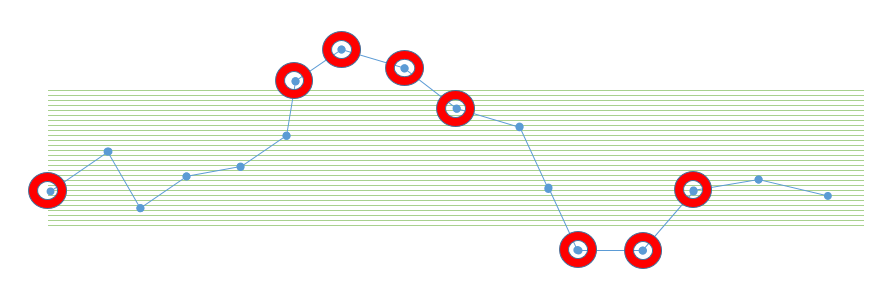
Here's an example of how
deadband()would pass through tuples for a sequence of values against the shaded dead band area. Circled values are ones that are passed through the filter to the returned stream.
- All tuples with a value outside the dead band.
- Two tuples with values within the dead band that are the first time values return to being in band after being outside of the dead band.
- The first tuple.
- Type Parameters:
T- Tuple type.V- Value type for the deadband function.- Parameters:
stream- Stream containing readings.value- Function to obtain the value passed to the deadband function.inBand- Function that defines the deadband.- Returns:
- Filtered stream.
-
-
-